Vanuatu has faced crisis after crisis over recent years. It began with Cyclone Pam in March 2015, followed by Tropical Cyclone Harold in April 2020, and then the global COVID-19 pandemic, which brought unprecedented disruptions worldwide. More recently, Tropical Cyclones Judy and Kevin struck in early 2023. Adding to these challenges, on December 17, 2024, a significant earthquake shook Vanuatu, causing further disruptions across the islands.
Each of these natural disasters has forced our children out of school, interrupting their education and slowing the nation’s progress. When we were still trying to recover from one crisis, another would come — testing our resilience time and time again.
And now, on top of these natural challenges, Vanuatu is facing a man-made disaster in the form of repeated nationwide teachers’ strikes. Teachers went on strike in 2024, and following a court ruling that made striking legal, another strike is planned in 2025 — continuing until a Collective Bargaining Agreement (CBA) is signed. This cycle of disruptions creates a heavy toll on our children’s future and the country’s development.
Timeline of Events
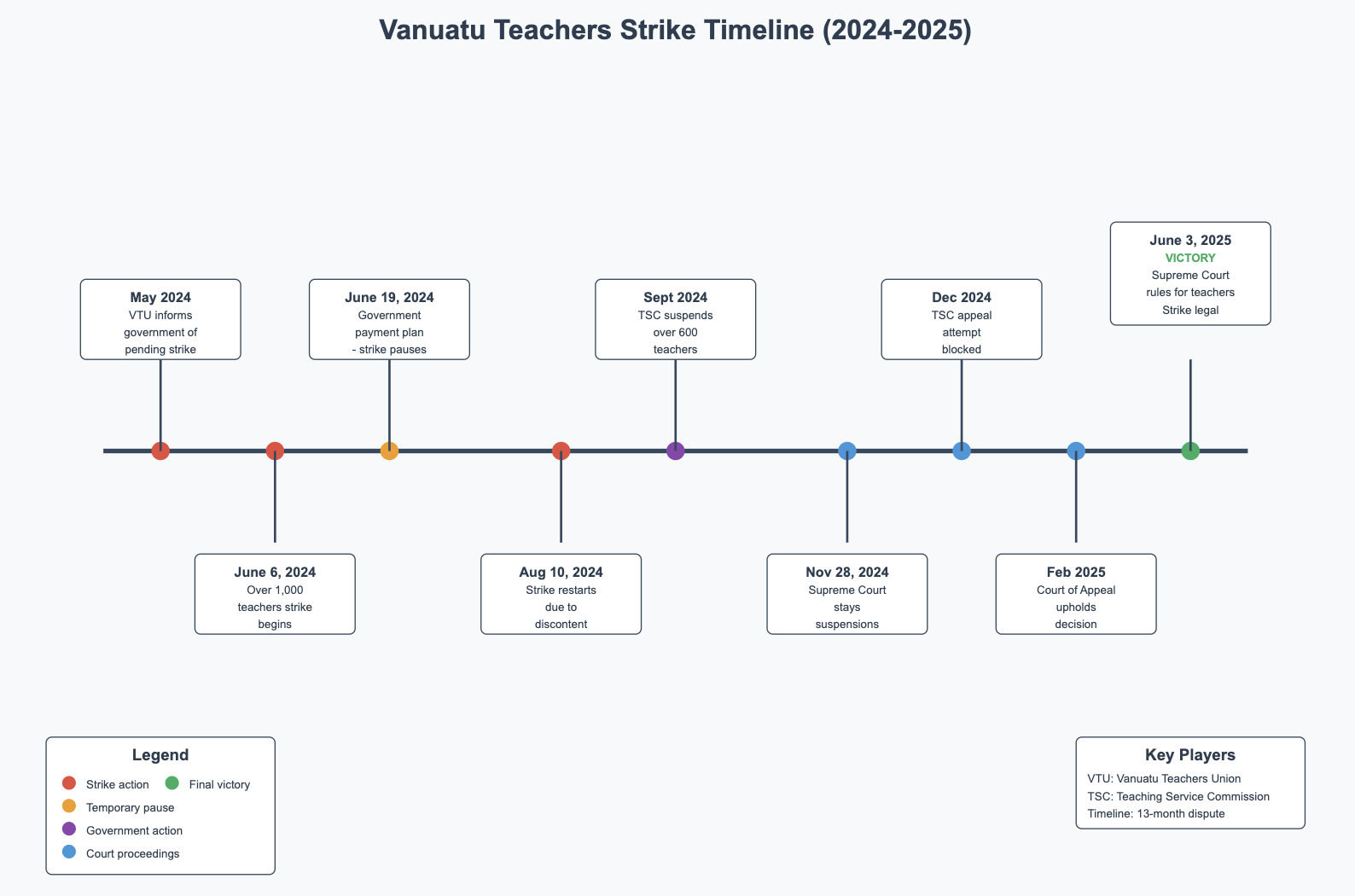
In May 2024, the Vanuatu Teachers Union officially informed the government of a pending strike due to unpaid entitlements. By June 6, over 1,000 teachers walked off the job. A short pause came on June 19 after the government offered a payment plan—but by August 10, discontentment led to the strike restarting.
Things escalated in September, when the Teaching Service Commission (TSC) suspended over 600 teachers. The VTU quickly turned to the courts, and on November 28, the Supreme Court stayed the suspensions. By December, the TSC’s appeal attempt was blocked, and in February 2025, the Court of Appeal upheld the decision.
Finally, on June 3, 2025, the Supreme Court ruled in favor of the teachers: the strike was legal, and the suspensions and terminations were overturned. A major legal and industrial win.
The Ripple Effects: How Disasters and Strikes Impact Vanuatu’s Progress
Natural disasters have devastating but understandable impacts: homes are damaged, infrastructure is broken, and recovery takes time and resources. Education is disrupted because safety and survival become priorities.
However, these man-made disruptions caused by strikes come at a time when Vanuatu is already struggling to rebuild. Each school closure delays children’s learning, and the gaps widen over time. When children miss critical years of education, it affects their skills, future employment prospects, and ultimately the economic and social progress of the nation.
Furthermore, progress in other sectors — from health to infrastructure to tourism — depends on an educated workforce. Interruptions in education slow down all these areas, creating a cycle that hinders national development.
Why Education Must Be Treated as an Essential Service
Teachers have valid concerns about pay and working conditions. But ongoing strikes pull children out of classrooms repeatedly, damaging the nation’s most valuable resource — its young people. The government must recognize education as an essential service, creating laws and policies that protect learning continuity even during disputes.
A Collective Bargaining Agreement (CBA) between the government and teachers is a necessary framework. It will allow for negotiation and resolution while minimizing educational disruptions.
Stronger Collaboration and Systems Needed
Agencies like the Teachers Service Commission (TSC) and Ministry of Education (MOE) need to work together closely. Sharing data and managing human resources through centralized systems can improve planning and reduce surprises.
Vanuatu’s existing VEMIS system is a good start — it tracks students, teachers, and schools in a shared digital platform. However, it requires further development: more training, better workflows, and wider access for administrators, teachers, and students. Strengthening this system will support education and help prevent future disruptions.
Automation: The Future for Efficient Teacher Management
To further improve efficiency and reduce administrative burdens, automation is an area that both TSC and MOE can explore deeply. Automating routine teacher registration processes, applications for certifications, and renewals can save time and reduce errors.
Imagine a fully digital workflow where teachers submit applications online, documents move seamlessly through approval stages, and notifications keep everyone updated. This not only speeds up processing but also improves transparency and accountability.
By automating tasks, the workload on staff is reduced, allowing them to focus more on supporting education directly. It also ensures data is accurate, centralized, and easily accessible for decision-making across departments.
Such improvements would strengthen the entire education ecosystem, supporting both teachers and students in more meaningful ways.
A Call to Teachers and Parents
Teachers, your role is critical to Vanuatu’s future. Strikes may feel necessary, but they harm the children you serve. Please seek dialogue and negotiation as ways forward.
Parents, your awareness and voices are vital too. Understand the broader impact of strikes on your children’s education and join calls for peaceful, constructive solutions.
Protecting Vanuatu’s Future
Our country has faced many natural disasters beyond our control. But repeated educational disruptions caused by strikes are avoidable. Together — through laws, agreements, cooperation, improved systems, and automation — we can protect our children’s right to learn and build a stronger, more resilient nation.
If your organization needs an assessment of your current systems and paperwork processes, Mattdotvu can provide expert analysis and practical recommendations to help streamline workflows and improve efficiency.
 Mattdotvu
Leave a comment