As the teachers’ strike continues to disrupt education across Vanuatu, images of students—particularly in Malekula—holding signs calling for the government to sign the Collective Bargaining Agreement (CBA) have surfaced on social media and news platforms. These images have sparked intense public debate: is the Vanuatu Teachers’ Union (VTU) using children as leverage to end a crisis it initiated?
This blog explores the legal, ethical, and public accountability dimensions of that question.
Background: How We Got Here
The VTU organized a lawful strike in 2024, citing the government’s failure to finalize the CBA. After multiple delays, failed negotiations, and government inaction, the union resumed the strike in August. In 2025, the Supreme Court ruled in VTU’s favor, declaring the action lawful and quashing the Teaching Service Commission’s (TSC) decision to suspend teachers.
While the legal victory solidified the union’s position, the strike’s continuation has left thousands of students without access to education. Parents are understandably frustrated. Many now feel the union, having caused the disruption, is turning to children as a tool to pressure the government into signing the agreement.
The Core Issue: Are Children Being Used in a Dispute Between Adults?
Photographs from Malekula show students holding banners reading:
“Mi wantem go bak long skul. Government please signem CBA.”
These signs are emotionally powerful—but who wrote them? Who organized the event? And are the children acting of their own will?
The concern from the community is clear:
“VTU started the strike. Now they’re using the children—whose education has been most harmed—to force the government to end it.”
Legal Analysis: Is This Even Allowed?
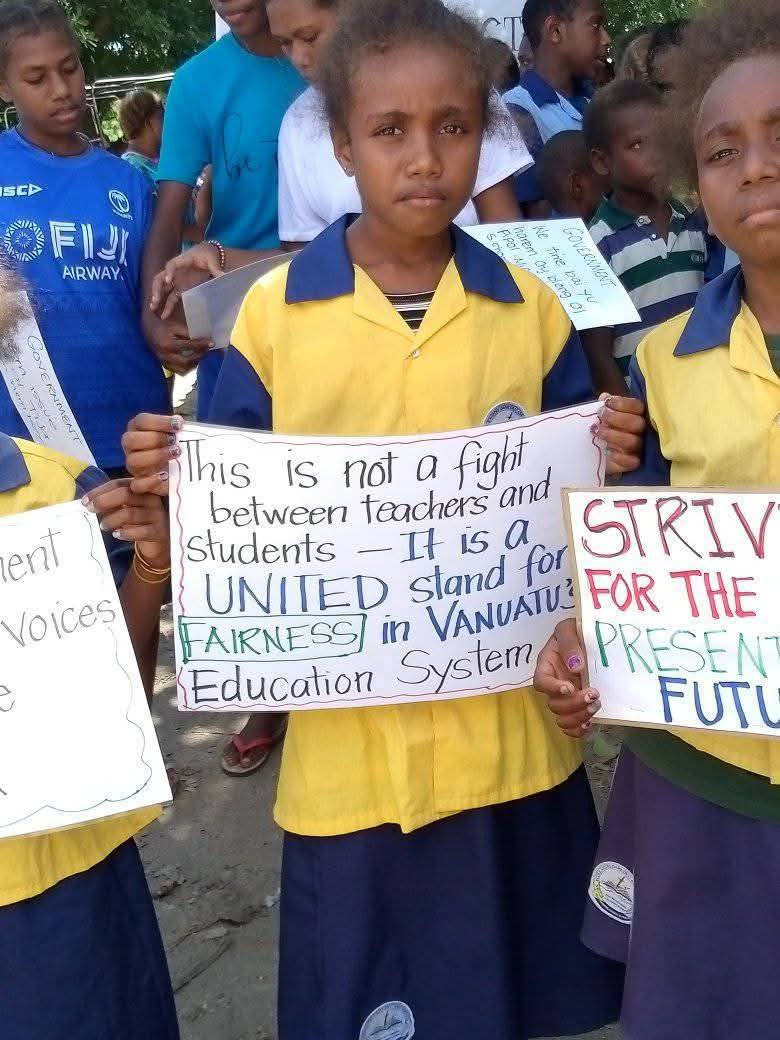
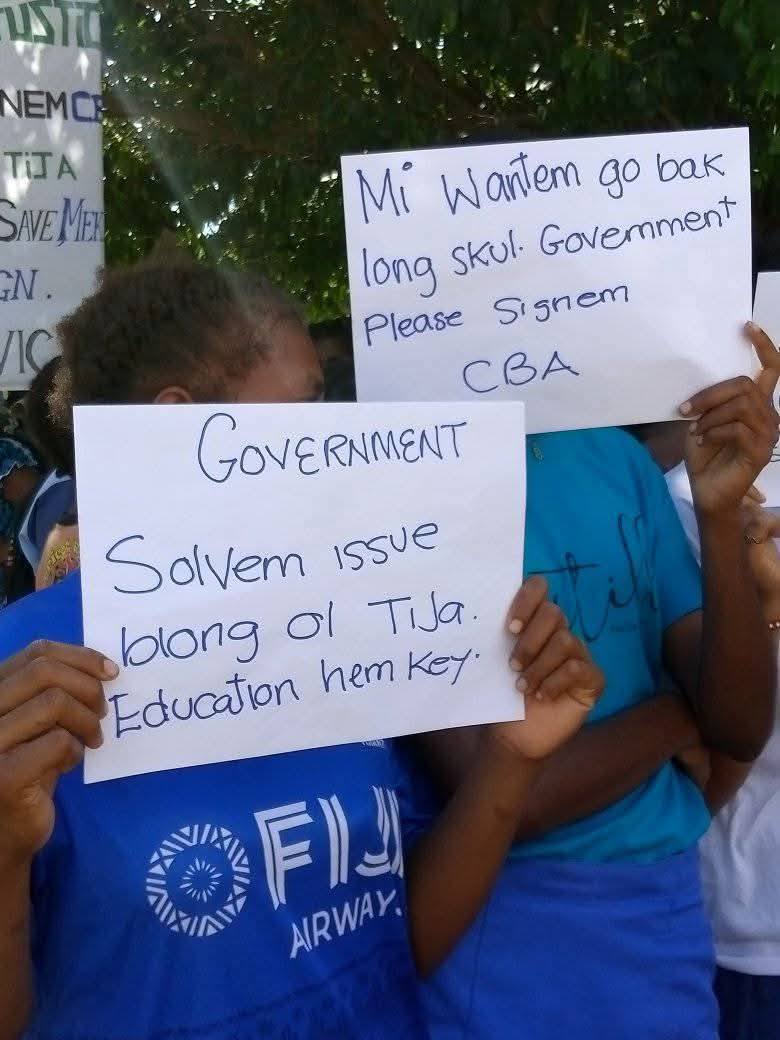
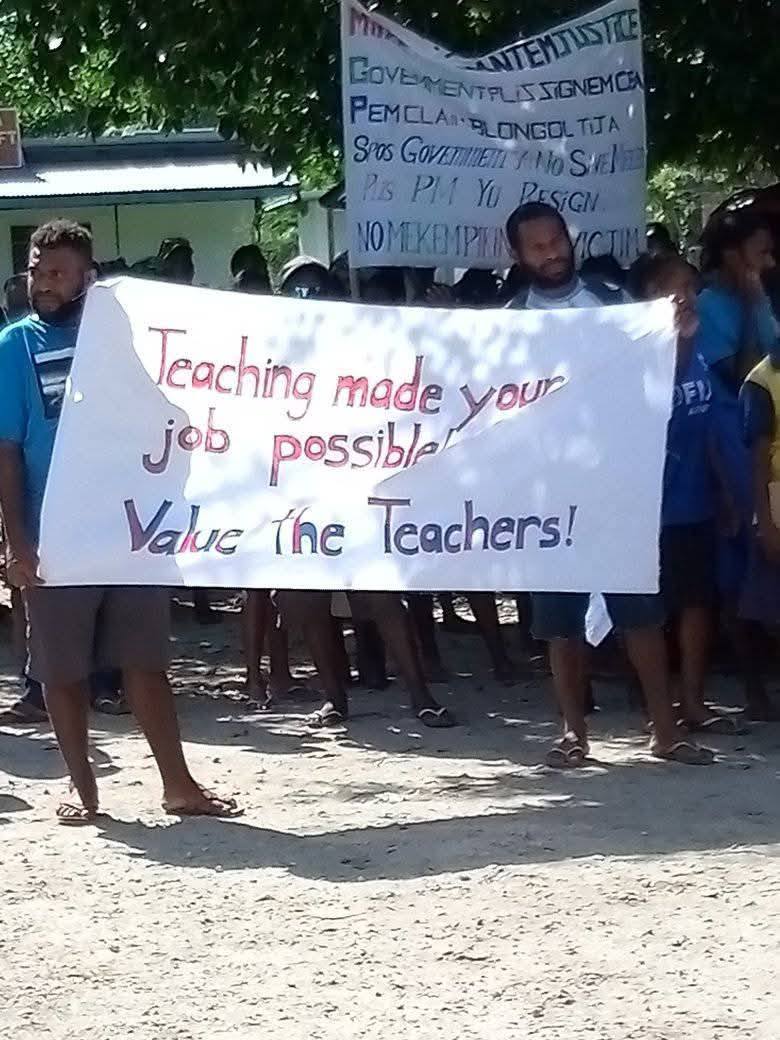
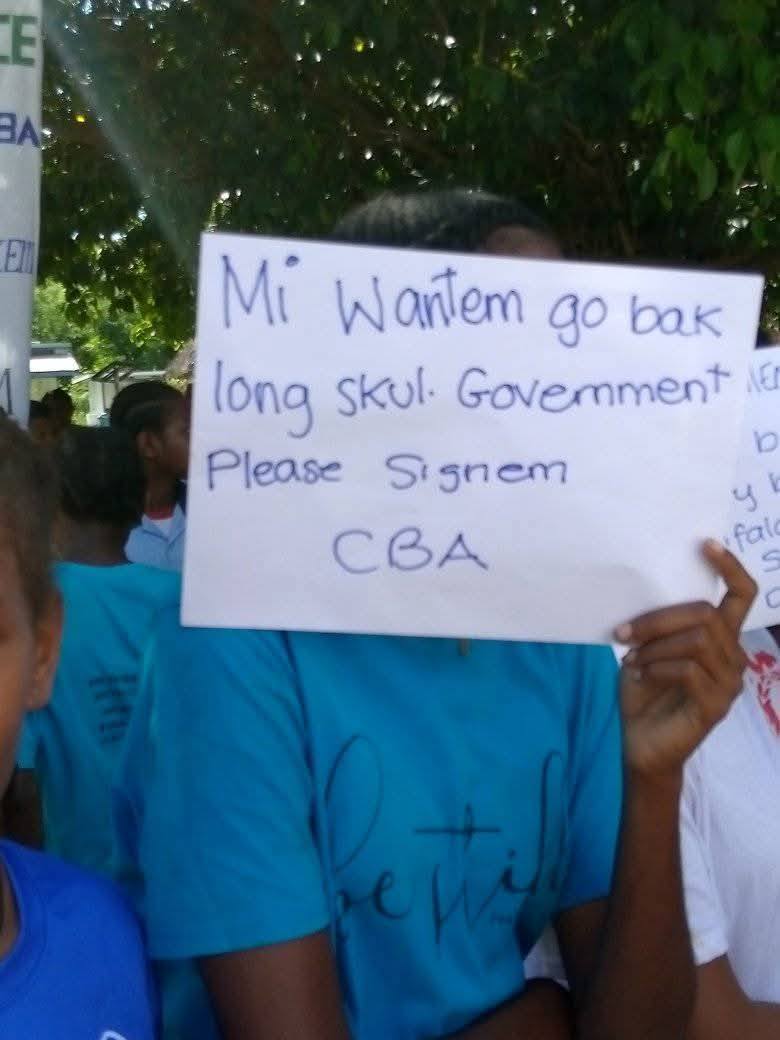
Participation of students in recent protests has raised questions about legality and ethics. Legally speaking, children in Vanuatu do have rights to express themselves and gather peacefully, as protected under both domestic and international law. As summarized:
“Under Vanuatu’s Constitution and the UN Convention on the Rights of the Child (ratified by Vanuatu), children have the right to freedom of expression and peaceful assembly. In principle, it is not illegal for students to participate in peaceful protests, especially if supervised, voluntary, and unrelated to school hours.”
Source: Article 5 and Article 30 of the Constitution of the Republic of Vanuatu; Articles 12 and 15 of the UN Convention on the Rights of the Child.
However, when children are guided or organized by adults—particularly in politically sensitive disputes—ethical concerns emerge. If students do not fully understand the context of the protests, or are being used to apply pressure in negotiations, the lines between lawful participation and manipulation begin to blur. The distinction between empowerment and exploitation becomes crucial.
However, there are important legal and ethical limits:
- If children are being directed by teachers or union officials without proper understanding or consent, it raises ethical concerns.
- If protests occur during school time without Ministry of Education approval, it may breach education policy.
- If connected to an ongoing legal matter, it risks indirect influence on the judiciary or government decision-making.
Ethical Balance: Empowerment or Exploitation?
This controversy forces a deeper ethical reflection:
| Community Concern | VTU Perspective |
|---|---|
| VTU caused the disruption, so using students is manipulative | Children have been harmed and have a right to speak out |
| Teachers are politicizing education | The government’s delay is politicizing education |
| Children are being used to force a settlement | Children are participants in a broken system and deserve a voice |
In reality, both sides bear responsibility. VTU lawfully initiated the strike to improve teacher conditions, but the government’s failure to act has prolonged its impact. The children are the ones paying the price.
Do Protesters Know What’s in the CBA? And Will It Benefit Them?
These protesters—parents, teachers, and children—calling for the government to “sign the CBA” must ask themselves a critical question: Do they actually know what’s in the agreement? And more importantly, what if it doesn’t benefit them at all? With emotions running high and education on pause, many are rallying behind a term—“CBA”—that remains vague and undefined in the public domain.
From what was seen in the 2024 draft version, the agreement appeared to focus narrowly on a financial transfer to the VTU’s bank account, with no visible provisions for teacher salary improvements, rural school upgrades, or student learning conditions. If that framework still holds, the public might be pressing for a resolution that, once signed, offers little to no direct benefit to the very people affected by the strike.
Making matters more complex, the actual content of the CBA remains undisclosed. VTU and government representatives claim the agreement is confidential, but this stance has drawn increasing criticism. When public funds—taxpayers’ money—are at the heart of the settlement, many argue the community has a right to know how those funds are being used. While confidentiality may be justified during sensitive negotiations, continued secrecy post-agreement undermines public trust, particularly when the strike has disrupted education nationwide. In the absence of full disclosure, calls to “sign the CBA” risk becoming symbolic, even misguided, rather than grounded in informed civic participation.
Did the Protesters Know That Billions Have Already Been Paid Out?
As calls to “sign the CBA” intensify, many in the public may not realize that government payments to teachers have already been underway. According to confirmed reports, the Ministry of Finance has been processing and disbursing verified claims submitted by VTU, with over 2 billion vatu already paid out to teachers under this mechanism.
This ongoing payment system appears to be functioning independently of any formal, signed CBA, suggesting that the financial redress VTU demanded is already being addressed in practice. If this is the case, it raises another critical question: Is the current public pressure—particularly by using children—still justified when payments are already being delivered? It also adds confusion about the true goal of the ongoing strike: Is it aimed at further reform, or simply formalizing what is already happening?
Conclusion: Rights, Responsibility, and Restraint
The VTU strike and the surrounding protests have placed the nation’s education system under intense scrutiny. At the heart of the issue lies a document—the CBA—that is widely misunderstood, yet passionately defended. While it is clear that teachers have legitimate grievances and the government bears responsibility for prolonged delays, the current public campaign—including the use of students—demands a higher standard of clarity and integrity.
If teachers are already receiving payments and the draft agreement offers no transformative reforms, then the public must ask: What exactly are we fighting for now?
Vanuatu cannot rebuild its education system on confusion and secrecy. Whether the CBA is signed or not, the process must be transparent, the outcomes must be meaningful, and the people—especially the children—deserve to know the truth. Anything less not only fails our students, it risks eroding public trust in the very institutions meant to represent and protect them.
Using children as part of a public message to resolve a strike is not illegal—but it is ethically sensitive. Their participation must be voluntary, informed, and protected from manipulation. Both the union and the government must act with transparency, restraint, and responsibility.
Because in the end, the children aren’t the tools.
They are the reason.
This article was prepared with the assistance of an AI legal prompt to support research and content drafting. While care has been taken to ensure accuracy, all opinions and conclusions reflect the author’s final review. Always seek advice from a qualified legal professional for any legal or ethical matters.
 Mattdotvu
Leave a comment