Paul Stephen Zebedee, widely known by his stage name Gazza, has made a significant return to the music scene, marking 13 years since his last participation in an album. His comeback comes through a new collaborative project with Souwia LSB, a release that has drawn strong attention from long-time followers of Vanuatu string band music.
Before joining Souwia LSB, Gazza was part of Tokosouwia, widely regarded as one of the best and most influential string bands Vanuatu has ever produced. In their prime, Tokosouwia dominated the local music scene and set a high standard for string band performance, popularity, and cultural impact. Gazza’s time with the group played an important role in shaping his musical identity and public recognition.
The new album features the song Mi Mestem, which uses symbolic storytelling rather than direct narration. The song draws on imagery of two birds separated by circumstance, with lingering connections compared to being caught in nanggol vines—a metaphor that carries deep cultural meaning for ni-Vanuatu listeners.
Gazza is well known for a catalogue of enduring songs that remain popular today, including Penama Queen, Koroi Kiki, Mared Laef, Lelei ni Taleva, among others. These tracks helped cement his reputation as a distinctive and respected voice in Vanuatu music.
Gazza’s musical foundation is deeply rooted in family and tradition. He grew up in a household shaped by string band music and was mentored from an early age by his uncle Ton Tony, a respected songwriter best known for PKL August Ngo Mindo, a composition widely recognised for its historical and social narrative. This musical lineage traces back to Emau Island, where several foundational string band groups emerged from the same extended family tree, including Sarapokasi, Tokotakia, and Souwia. Over time, different family groupings evolved into hybrid formations such as Saratokowia and Tokosouwia, reinforcing a multi-generational legacy that has significantly shaped Vanuatu’s string band movement.
Later in his career, Gazza deliberately expanded into contemporary pop production, a transition that produced commercially successful tracks such as Koroi Kiki, which emerged around 2009 and became one of Vanuatu’s most recognisable zouk-influenced pop recordings, remaining rhythmically relevant to this day. Penama Queen followed as another pop-oriented project, further broadening his audience. This stylistic evolution was supported and elevated through studio collaboration and production guidance from Paxton Beat and Darren Wu of Master Sound Studio, whose arrangement, mixing, and production direction helped position Gazza firmly within Vanuatu’s modern pop soundscape.
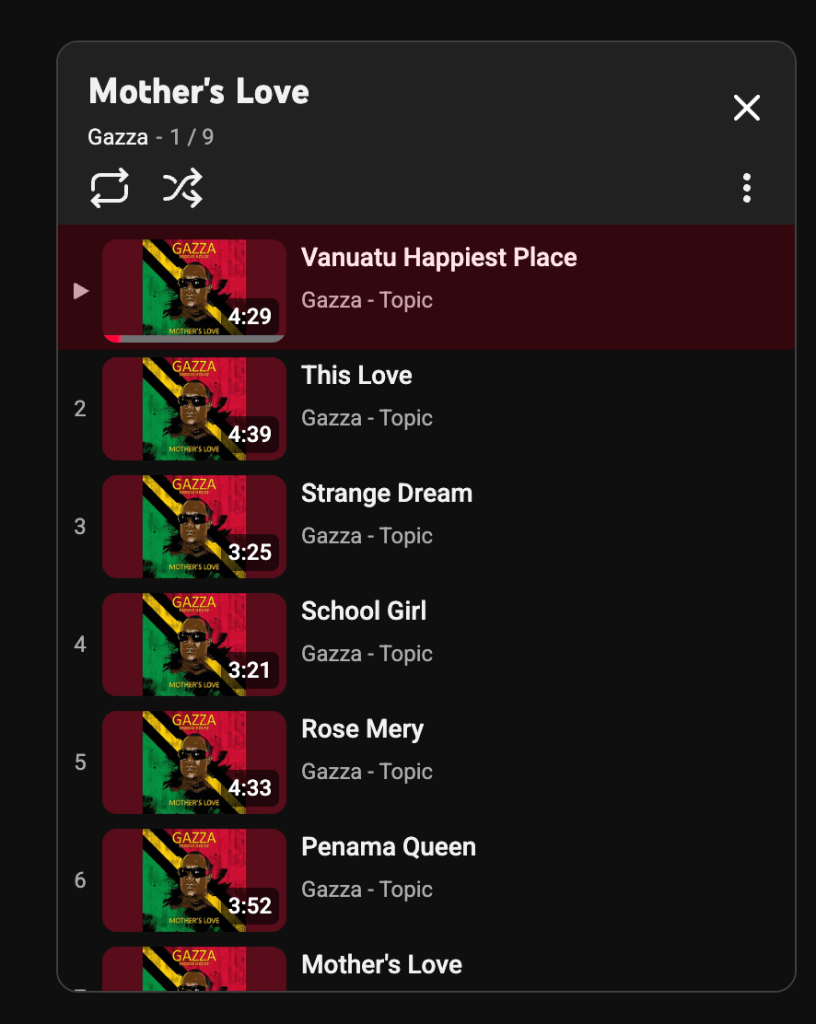
To round out his return, listeners are encouraged to revisit a playlist of Gazza’s pop-era sound, which captures his crossover from traditional roots into contemporary production. The playlist highlights enduring tracks such as Koroi Kiki—a zouk-influenced pop release from around 2009 that remains rhythmically fresh today—alongside Penama Queen, a polished pop project that broadened his national appeal. Together with other selections from this period, the playlist reflects Gazza’s adaptability, melodic instincts, and his role in shaping a modern Vanuatu pop sound that continues to resonate across generations.
The new album and promotional materials are now available through local outlets. Physical copies are reportedly on sale at George Pombidou (Bougainville Street), opposite MIPU, with audio and video formats also accessible online.
 Mattdotvu
Leave a comment